How The Internet Runs Underwater
The modern internet feels wireless and weightless, but most global data still moves through fiber-optic cables laid across the ocean floor.
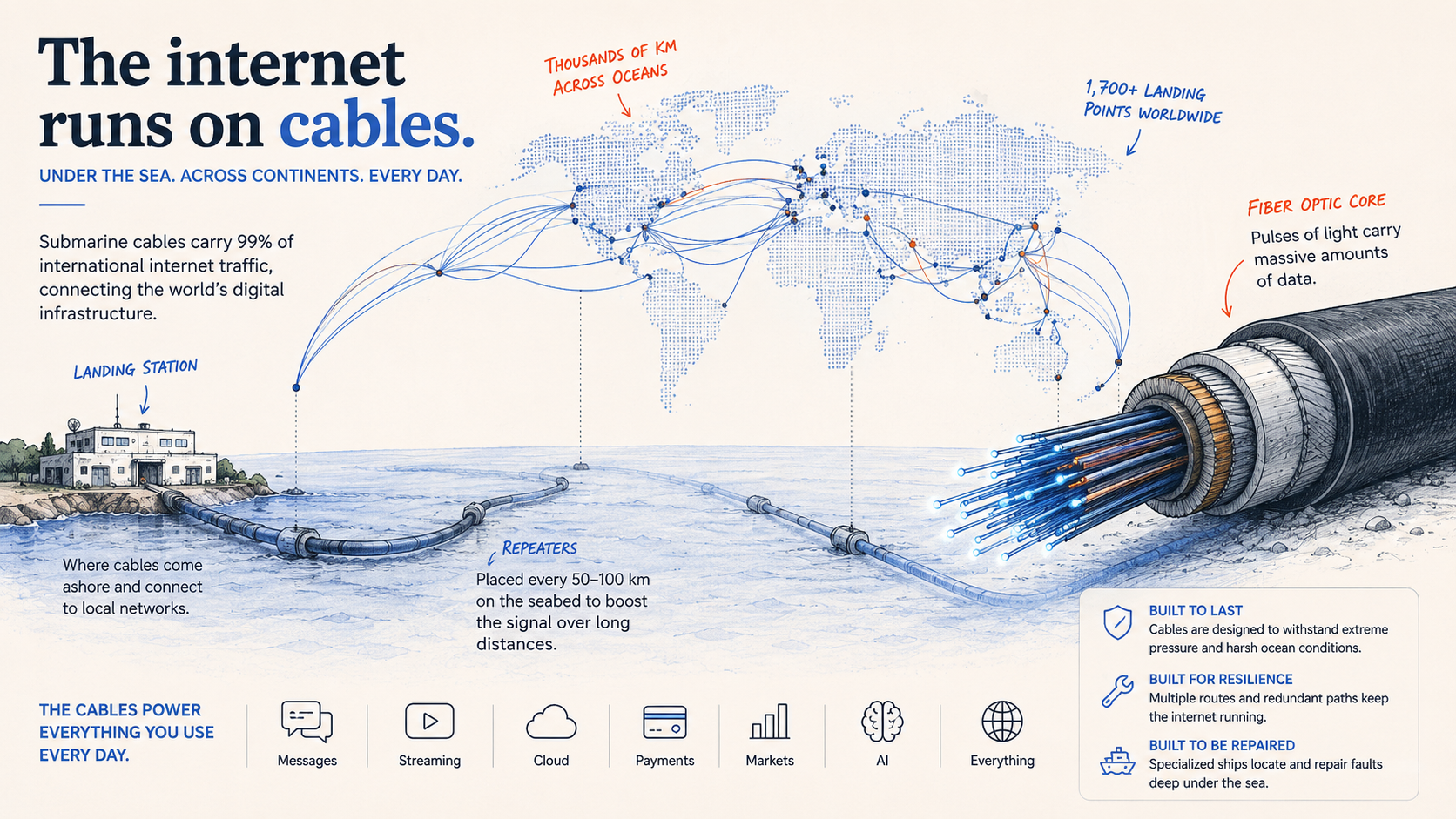
Open a website on your phone and the first part of the trip is wireless. The signal travels from the phone to a Wi-Fi router or mobile tower. After that, it usually enters a fiber network.
If the website is hosted on another continent, the request may eventually reach a cable landing station on the coast, cross the ocean through glass fibers, and return through another terrestrial network. Satellites serve important roles, especially where fiber is unavailable, but they carry only a small share of intercontinental internet traffic.
The global internet works because hundreds of physical cable systems connect national networks and data centers across the seabed.
What is inside a submarine cable?
A modern submarine cable contains pairs of optical fibers. Lasers encode data as pulses of light, and repeaters placed along long routes amplify the signal before it becomes too weak to read.
The cable's construction depends on where it will be installed. Across the deep ocean, where anchors and fishing gear are less likely to reach it, a cable can be roughly the width of a garden hose. Near shore, it receives additional steel armor and may be buried beneath the seabed. The optical fibers themselves are much thinner than the protective structure around them.
At either end, the cable enters a landing station. From there, terrestrial fiber carries the traffic toward internet exchanges, carrier networks, and data centers.
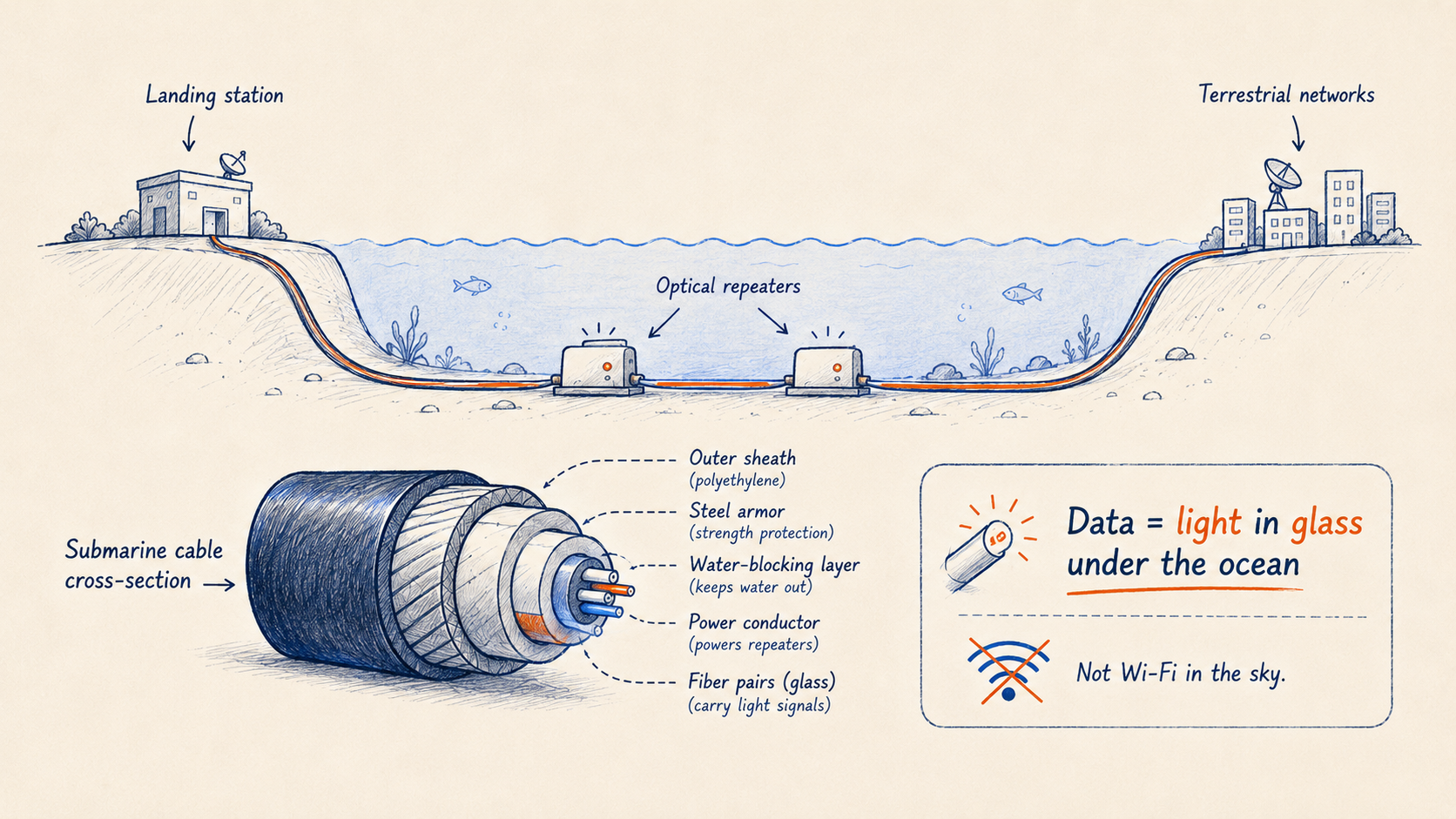
Consider a request from Tbilisi to a service running in a US data center. It may travel over local fiber into a regional network, pass through several routers, cross an ocean cable, and continue through a US carrier before reaching the server. The response follows an available route back. Routing policy, congestion, and failures can change the exact path from one request to the next.
The word “cloud” is useful because customers do not need to manage this machinery themselves. It can also make the machinery easy to forget. A cloud region still needs physical routes to its users and to other regions.
Why fiber carries most intercontinental traffic
TeleGeography estimates that submarine cables carry more than 99% of intercontinental data traffic. The exact share cannot be calculated perfectly because comparable satellite traffic data is limited, but the difference in capacity is not close.
Satellites are valuable for ships, aircraft, remote communities, disaster response, and places where laying fiber is impractical. Their strength is reach. Fiber's advantages are capacity and cost per bit. On busy routes between continents, a cable can move far more data economically than a satellite system.
Latency also depends on the route. Light travels more slowly through glass than through a vacuum, but a fiber route can still be shorter than a satellite path. Low Earth orbit systems have reduced satellite latency substantially, yet ground stations and network topology remain part of the trip. Neither technology escapes geography.
For most phone users, “wireless internet” describes the access link. Once traffic leaves the nearby tower or router, fiber carries much of the remaining journey.
Why cloud companies invest in cables
Submarine cables were traditionally financed by groups of telecommunications carriers. Carriers still own and operate a large part of the network, but major cloud and platform companies now invest directly because their services create enormous demand between regions.
Google said in 2018 that it had direct investment in 11 submarine cables, in addition to capacity leased on other systems. Meta has since announced projects such as Waterworth, a planned route spanning five continents.
Owning fiber pairs or participating in a cable consortium gives a company more control over capacity, route planning, and upgrades. It does not make the company independent of the wider internet. A cable still lands in particular jurisdictions, connects through terrestrial networks, and depends on shared repair capacity.
For a cloud provider, route diversity matters as much as raw bandwidth. Two nominally separate connections may share a landing station or pass through the same narrow corridor. A single incident can affect both unless their physical paths genuinely diverge.
What happens when a cable breaks?
Cable faults are routine enough that operators design networks around them. TeleGeography's submarine cable FAQ cites roughly 200 faults per year. Most users never notice because traffic is shifted onto other cables.
Fishing and anchoring cause much of the damage, particularly in shallower water near coastlines. Earthquakes, underwater landslides, abrasion, and equipment failures account for other cases. Deliberate sabotage receives more attention, but ordinary maritime activity is a more common cause.
The International Cable Protection Committee attributes about 30% of annual incidents, around 60 faults, to dragged anchors. It estimates a typical telecommunications cable repair at £500,000 to £1 million.
Repair requires specialized ships. Crews locate the fault, recover the cable from the seabed, splice and test it, then lower it back into place. Weather, water depth, permits, and the availability of a repair vessel can determine how long the work takes.
Meanwhile, routing protocols move traffic to surviving paths. If those paths have enough spare capacity, users may see little change. If they are congested or geographically indirect, latency rises and service can degrade.
Chokepoints and route diversity
Cable routes are constrained by geography. The Red Sea and Mediterranean form an important corridor between Europe and Asia; the Strait of Malacca concentrates connections around Southeast Asia. Dense groups of cables also converge at particular landing areas.
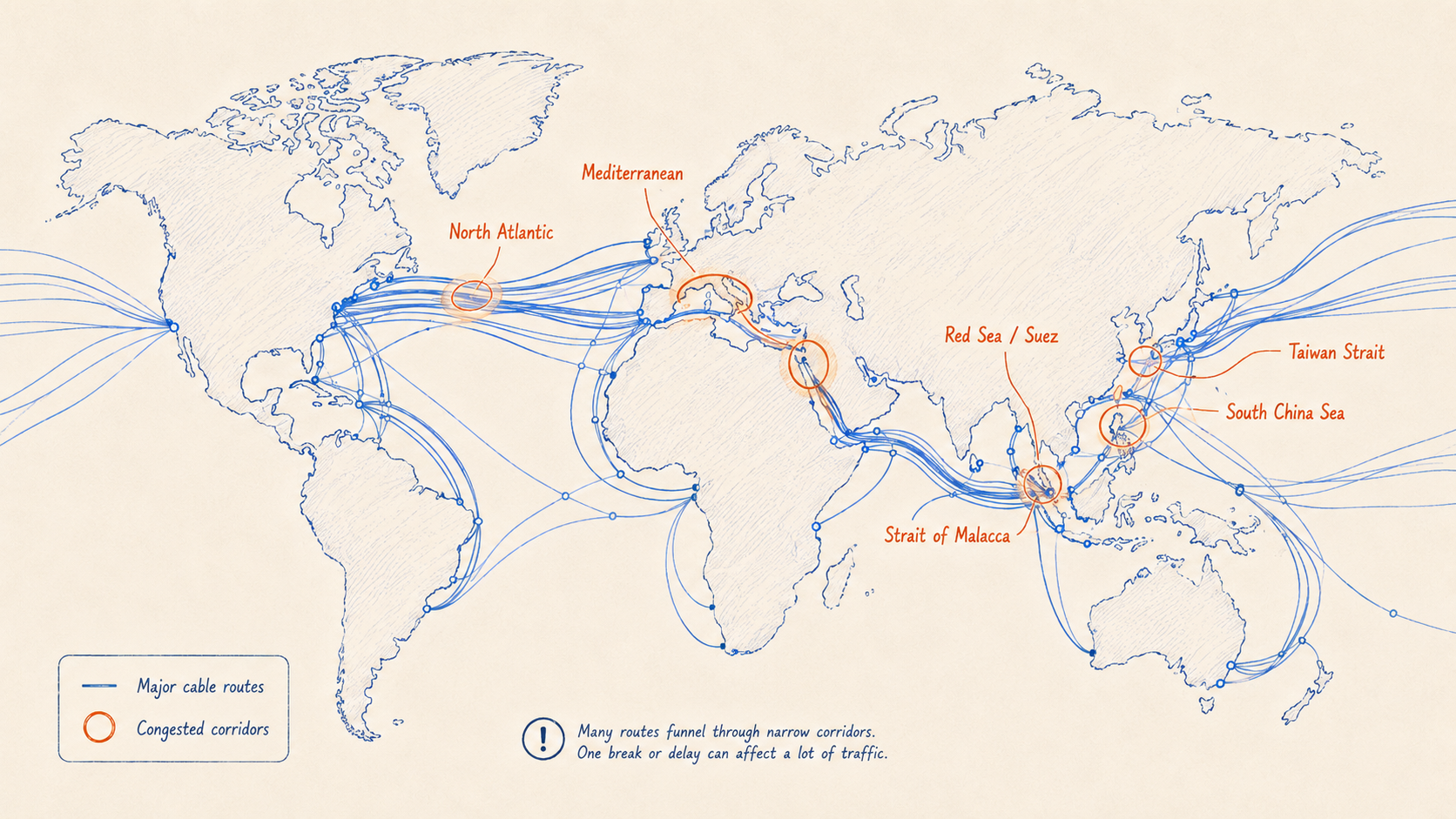
Concentration is efficient until several systems in the same corridor fail or become difficult to repair. Networks can route around a damaged cable, but an alternative path may add distance or have less available capacity.
This is why a cable map also describes political and operational risk. A route may cross territorial waters, require permits from several governments, or land where only a few operators control onward connections. Repair ships need permission and physical access. Ownership determines who can use capacity and on what terms.
The practical question for a network operator is specific: after one route fails, is there another route with a different landing point and enough spare capacity to carry the traffic?
Where AI fits
AI does not create a new kind of network traffic. Training data, model checkpoints, API requests, and inference responses are still packets moving through data centers and fiber.
What changes is the amount and location of that traffic. Large training jobs may copy datasets and checkpoints between facilities. Consumer inference sends requests from many countries to a smaller number of regions with suitable accelerators. Companies running services in several regions also move model versions, logs, and customer data between them.
This does not mean every AI workload crosses an ocean. Providers often place compute close to users, and data-residency rules can keep processing within a region. But when compute capacity is concentrated in particular locations, the links into those locations become part of the service's performance and resilience.
Meta explicitly connects its planned Waterworth cable to supporting AI services. That is one company's infrastructure strategy, not proof that AI alone is driving the cable market. Video, cloud storage, enterprise software, messaging, and ordinary web traffic continue to account for substantial demand.
The useful point is simpler: GPUs do not remove the need for networks. A fast cluster with poor external connectivity is difficult to use as part of a global product.
The route behind the request
Most people do not need to know which cable carried a video call or payment. That is a sign that the network is doing its job.
The physical route becomes visible when it fails. A damaged cable can push traffic onto a longer path. A congested landing point can slow access to an otherwise healthy cloud region. A country with only a few international routes has less room to absorb a fault.
The internet may feel wireless at its edges, but long-distance connectivity depends on fiber, landing stations, repeaters, routers, and repair crews. The cloud works because this physical system usually stays out of sight.